Please read review on SOUNDREBELs website: https://soundrebels.com/
Even a novice vinyl scratcher knows perfectly well that, while virtually every component, such as the mechanism, tonearm, or platter drive, has an audible impact on the final sound of an analog conglomerate, it’s the cartridge that truly matters most. It’s the cartridge that begins the process of interpreting the information contained in the record groove, so creating even the best operating conditions for it, despite the other technical aspects of the turntable mentioned above, will only be about maximizing its true self. Sometimes it flows with milk and honey, sometimes it’s aggressive in the right sense of the word, and still others it combines both. And while it might seem that choosing the right stylus would be a piece of cake, actually, trying to meet the core of our expectations becomes a challenge. Worse still, the more refined the cartridge, the steeper the hurdles become, as the quality of its build automatically goes hand in hand with the quantity and quality of the information it delivers, and that’s no small feat. How do I know? Naturally, this is from personal experience, supported by my recent search for my ultimate turntable. I wrote about my adventures in choosing a drive unit and why I chose this one and not another in a series of tests, so now, as a sort of culmination of that process, it’s time to take a look at the final cartridge. Which one? Naturally, one that was adequate in quality to the drive unit, which turned out to be the flagship design from the Japanese powerhouse in this field, distributed by RCM in Katowice – they custom-make such designs for practically half the analog world, according to the specifications of the customer. Yes, yes, it’s a model with a diamond cantilever, currently the most appreciated by music lovers, so while encouraging you to read the text below, the only thing I can reveal in this editorial is the phrase – things are going to happen.

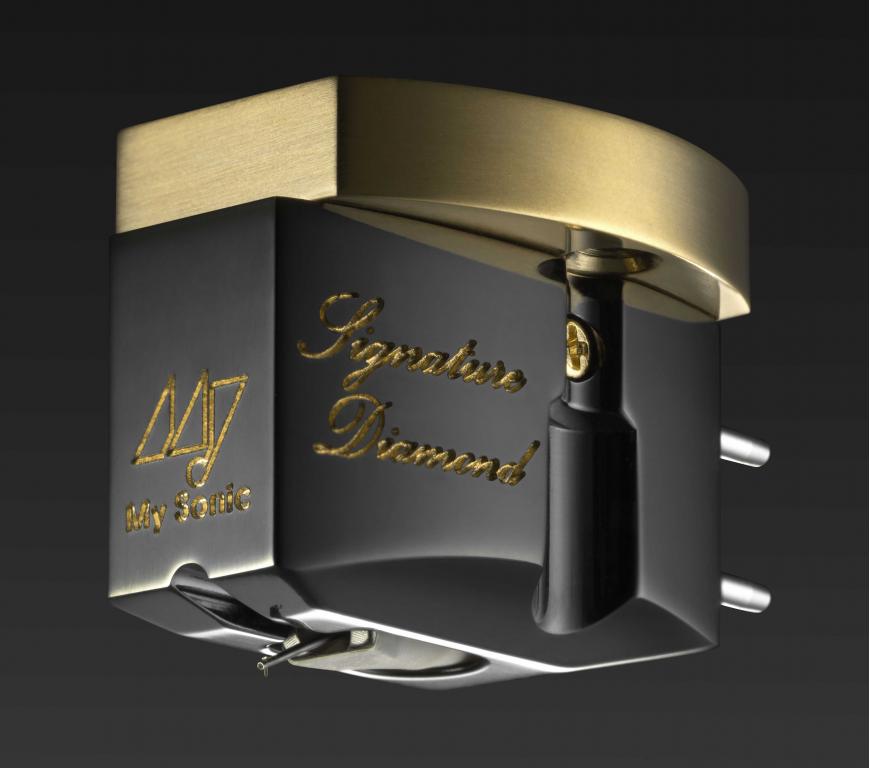
The Signature Diamond, due to its top-of-the-line price tag, is the manufacturer’s most technically and materially refined cartridge. Its housing is made of titanium, but unlike the housing of the lower-end model, it is additionally surface-hardened using the Black IP process. As mentioned in the editorial, this model features a diamond cantilever. The manufacturer believes this choice of material, compared to semi-finished products used in other models, ensures significantly improved energy transfer. However, unlike similar cartridges from other brands, it is not a solid, round or rectangular piece of this precious metal, but a conical tube. The goal? The cantilever, made using this technology—the combination of a diamond and its conical profile—is designed to achieve excellent clarity, and thus tangibility, as well as a certain unobtrusive fluidity and homogeneity of presentation, which is undeniably the essence of enjoying music from a turntable. To conclude the description of the construction, I will not dwell on specific calibration data here, as you will find them under the test, but I will add that compared to a large group of manufacturers of such advanced cartridges, the cartridge in question is very user-friendly in terms of settings, which means that it can be used with practically the full range of potential phono preamplifiers, which I also know from experience is an obvious advantage.
What do I think about the approach to music offered by the flagship My Sonic Lab cartridge? Before I get into specifics, a few words about the counter-proposal from the same manufacturer, the Eminent EX, used when selecting my final turntable. It’s a very lively and energetic cartridge. It sounds without trying to charm the listener, playing with a nice punch—within reason—at the extremes of the frequency range, making it ideal for comparing different types of transports. It demonstrates excellent bass extension and openness at the top, but importantly, without unduly heating up the midrange. But just to be clear, despite this approach, its sonic offerings are so compelling that if the chosen turntable didn’t allow for something more refined, and if for some reason I didn’t have a slightly larger budget for this element of the analog circuit, it would likely stay with me permanently, providing me with a lot of enjoyment. Of course, the initial assumptions were different, so when I finally decided on a specific model, I asked the distributor what he would suggest based on his experience and knowledge of my expectations. Without hesitation, he said, “Only a diamond,” and if so, then the expressive flagship Kuzma or the more humane, in terms of timbre and organicity, top-of-the-line My Sonic Lab. Of course, given the emphasis on well-placed sound in the midrange, the Japanese model was chosen. What did it do compared to the basic model? Firstly, it created a phenomenal, never-before-heard virtual spectacle in terms of purity and, therefore, immediacy of perception. Secondly, it delicately tempered the harshness by increasing the resolution of the highest registers, and in a positive sense, the owl fragmented the low frequencies, previously perceived as slightly averaged into a single, sloppy impulse, into countless micro-information. Thirdly, it elevated the midrange, full of life and vibrancy, pulsating with a joy I had never heard before, to the status of equal rights with the extremes of the frequency range. The effect was unbelievable, as typically boosting the midrange results in a greater or lesser averaging of the sound, but here it was quite the opposite; I felt something akin to the music being infused with unfettered vitality, volatility, and the aforementioned organic quality. Admittedly, when I interpreted the manufacturer’s message to a potential customer regarding this cartridge’s performance in the construction section, I mentioned the theoretical possibility of such a phenomenon, but after years of testing, I’d learned more than once that this was often just wishful thinking, I left myself a considerable margin for initial oohs and aahs. Unfortunately, after the cartridge had burned in, it proved unnecessary, as it, colloquially speaking, knocked me out. And it did so by offering a powerful, clean, and fast impulse.It brilliantly shined in the fully controlled, phenomenal low frequencies, eliminating any sense of veiling without feeling overexcited in the treble. The music simply exploded with a riot of sonic nuances most anticipated at the extreme high end. So successfully across the full spectrum of the music I was listening to, that it was able to draw me into the vortex of every sonic event from beginning to end, covering every record from classical, through jazz, to rock. You might not know, but I even have four-disc releases in my collection.
While it’s not a four-disc set, but a two-disc set, it’s a very good example of how the reviewed cartridge handled challenging material. This is a concert report from a tandem concert with the symphony orchestra of the rebel band from my youth, Metallica “S&M .” As you might imagine, this is a rock concert with a strong, well-defined energy, in terms of quantity and resolution, which almost automatically prepares us for a collision with a rather poorly produced recording. A recording that, let’s be honest, could easily be described as heavily compressed. However, the cartridge’s articulated sonic characteristics, such as good bass management, vibrant midrange, and transparent, slightly warm treble, made the album sound surprisingly engaging. This is because the compression effect in question wasn’t particularly painful, but thanks to the phenomenal resolution of the presentation, everything came out in the band’s appropriately aggressive aesthetic, enveloped in a truly minimal amount of distortion. How this happened, I have no idea, but the whole thing was presented very clearly on a proverbial platter in a way unique to itself. And I’m not just talking about the vocals or the powerful and lush guitar performances, but also the often-repeated background section of purring double basses, rather than the monotonous drone of the basses. The latter are intended to be merely an addition, often lost in the general chaos of poor reproductions of this material. However, during the test, they were a supporting element, but perfectly defined in the air and well-embedded in the stage mass. Needless to say, it was a positive shock, as it was the first sonic positive I observed demonstrating the cartridge’s resolution. And what happened on the other side of the barricade? To this end, a live performance of Diana Krall, this time charming and well-mastered, with her album “Wallflower,”
was also presented on the platter . And if the sound engineer had been diligent, from the very first note, there was nothing else possible but for my senses to be automatically and endlessly immersed in the music and Diana’s vocal instrument’s manipulation of the sonic nuances. It was magic with a capital “M,” as it relied not only on the exquisite reproduction of this intimate-sounding vocalization, but also on its projection in my room, capturing the timbre and facial expressions of the artist, the sound of the instruments in the concert, and the environment in which the event was being performed. For me, this was the proverbial icing on the cake, meaning I decided not to return this cartridge to the distributor after the review.
Who would I recommend this cartridge to? As the above description suggests, to anyone expecting true analog beauty. On the one hand, appropriate aggression in the projection of the frequency range extremes, enriched by a vital midrange, and on the other, thanks to resolution, not to brightening, a phenomenally pure presentation of the music being listened to, thus devoid of the feeling of separating the listener from the virtual stage with a hint of haze. These are the two most important features of this stylus, which are hard to find in such a complete package in other designs, even at the same price level, from competitors. Am I stretching the facts to justify my expensive choice? Not at all, because each, but I mean each cartridge model – even the most expensive ones – has a slightly different defined DNA code, and as we know, this one is inimitable. Yes, it may be close to the My Sonic Lam Signature Diamond described in the above review, but as is often the case, the devil will be in the details. Details that, in this case, matched my expectations so perfectly that I saw no point in further searching. It was a classic checkmate.